


Yana Kysla
IT Department Director, Global Spirits

How data centralization works
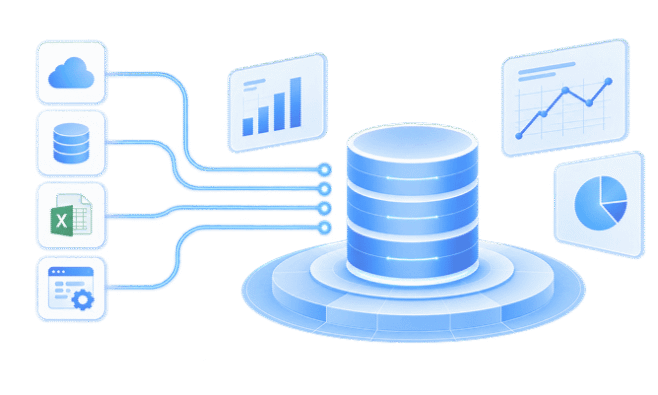
In most companies, data lives in different systems. Sales data is in the CRM, financial data in accounting software, operational metrics in the ERP, and some information in Excel. Each source operates separately and shows only part of the picture.
Centralization changes how information is handled in four stages:
-
Data collection
(Extract)Data automatically flows from different systems and sources into a single environment for further processing.
-
Cleansing and standardization (Transform)
Data is cleansed and standardized to follow consistent rules, formats, and structures.
-
Validation and reconciliation
If the same entity has different names, codes, or formats across systems, these differences are identified and reconciled before reports are built.
-
Loading into the warehouse (Load)
The prepared data is loaded into a single warehouse, forming the foundation for BI dashboards, management reporting, and further analytics.
A simple example from an international manufacturing and distribution group
Before centralization
A manager wants a complete view of sales. One distributor sends data automatically. Another sends an Excel file. A third uses its own accounting system. An analyst manually collects everything, reconciles the figures, and looks for discrepancies. This takes time, delaying the manager’s access to up-to-date information.

After centralization
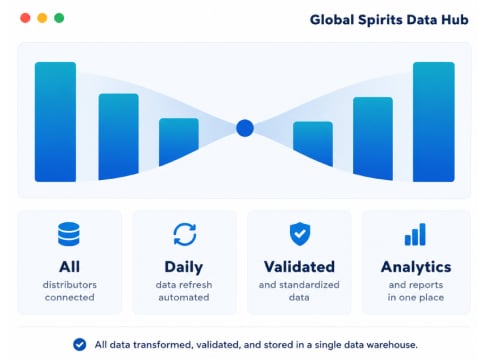
Data from all distributors automatically flows into a single warehouse. The system standardizes the format, validates the data, and prepares it for analytics. The manager opens a dashboard and sees consistent metrics without anyone having to consolidate files manually.

Getting started
How to get started with
Data Warehouse / Data Integration
Start by identifying your main business challenge and sharing
the data and systems you work with.
We will help assess your current setup and recommend
the right approach to integration.
-
01
Book a
consultationTell us about your challenge, current systems, and analytics needs so we can explore what your future solution could deliver.
-
02
Define your
business goalsTogether, we will define the problems to solve, the metrics to track, and the analytics your system needs to support.
-
03
Share data
for assessmentShare sample data and how it is transferred so the Cobit Solutions team can assess its structure, formats, quality, and integration requirements.
-
04
Get your
solution roadmapAfter the assessment, you will have a clear view of the proposed architecture, key implementation stages, and data preparation needed for reporting and analytics.
Your first 30 minutes of consultation are free.
Find out where to start your project
and which solution best fits your business.
Ready to speed up corporate analytics?
Stop wasting time on manual report preparation — automate corporate analytics with Cobit Solutions.
Or text us via Messenger



Why organizations are choosing our
Power BI implementation services
Our Power BI development work is based on solutions that directly improve decision-making quality. We help organizations structure data, connect key sources, and deliver Power BI development services that provide a clear view of performance metrics. Our team turns reporting into a practical management instrument that supports confident decisions and sustainable business growth.

Start in 1 week, work on EST hours, get results fast

25+ Data, BI & Finance experts ready to help

8+ years delivering data solutions in 22+ industries

Trusted by 70+ clients across 5 countries

Save 40% vs. building the same team in-house

Full end-to-end delivery, from DWH to support & AI







Need expert Power BI support for your project? Hire Power BI developers and get tailored BI solutions
built for clarity, control, and measurable results.
We also offer you to familiarize yourself with our other projects

Healthcare
“Dobrobut” clinics network
Result:
- The clinic’s directors receive a P&L report updated daily.
- Management uses a daily dashboard for budget-versus-actual analysis of operational indicators.
- Dashboards combine data from ERP and the Doktor Eleks medical system.

Logistics
Meest China
Result:
- Dashboards combine data from ERP and CRM.
- Route margins are automatically calculated in dashboards and monitored every day by management.
- A Profit & Loss report is generated daily.

Manufacturing
Steelite International USA
Result:
- Automated reporting, reducing turnaround from 10 days to overnight.
- Scaled visibility from regional to global (US, UK, Canada, Europe, Australia).
- Centralized data enabled data-driven decisions on a weekly cadence instead of monthly.
Industry-focused case studies designed for your needs