







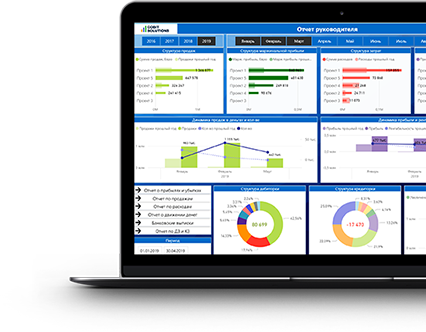
Current environment assessment
Review of your data sources, business systems, and reporting workflows.

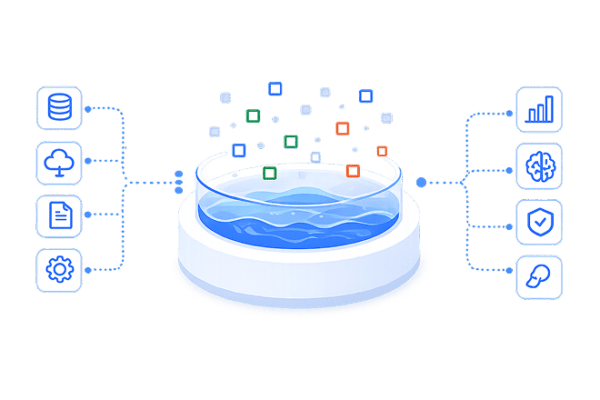
Unified ERP, CRM, and financial data.

Integrated operational and external data sources.

Trusted data for BI, forecasting, automation, and AI.

for cost-effective implementation
The Challenge |
What We Build |
|---|---|
 Data is scattered across multiple systems
ERP, CRM, finance, operations, APIs, and files are disconnected.
Data is scattered across multiple systems
ERP, CRM, finance, operations, APIs, and files are disconnected.
|
 A unified data foundation
Bring business data into one governed environment.
A unified data foundation
Bring business data into one governed environment.
|
 Reporting is slow or difficult to trust
Teams manually reconcile numbers before reports can be used.
Reporting is slow or difficult to trust
Teams manually reconcile numbers before reports can be used.
|
 Trusted reporting and analytics
Improve confidence in dashboards, KPIs, and business reporting.
Trusted reporting and analytics
Improve confidence in dashboards, KPIs, and business reporting.
|
 AI initiatives are blocked by poor data quality
Data is incomplete, inconsistent, duplicated, or lacks history.
AI initiatives are blocked by poor data quality
Data is incomplete, inconsistent, duplicated, or lacks history.
|
 AI-ready datasets
Prepare clean, structured data for AI and forecasting.
AI-ready datasets
Prepare clean, structured data for AI and forecasting.
|
 Data storage and processing costs keep growing
Growing volumes increase storage, processing, and maintenance expenses.
Data storage and processing costs keep growing
Growing volumes increase storage, processing, and maintenance expenses.
|
 Optimized data operations
Reduce storage and processing costs through better architecture.
Optimized data operations
Reduce storage and processing costs through better architecture.
|
 The data lake has become a data swamp
Data exists but lacks governance, documentation, quality controls, and business usability.
The data lake has become a data swamp
Data exists but lacks governance, documentation, quality controls, and business usability.
|
 Governance and quality controls
Implement security, ownership, cataloging, and quality monitoring.
Governance and quality controls
Implement security, ownership, cataloging, and quality monitoring.
|
 There is no clear architecture roadmap
Teams are unsure which platform and architecture to choose.
There is no clear architecture roadmap
Teams are unsure which platform and architecture to choose.
|
 A scalable architecture strategy
Create a roadmap for BI, lakehouse, and AI growth.
A scalable architecture strategy
Create a roadmap for BI, lakehouse, and AI growth.
|

A well-designed data lake helps organizations unify data, support AI initiatives, and
make decisions with greater confidence.

Architecture Comparison
As data volumes, reporting requirements, and AI initiatives grow, many organizations face the same question: should they build a data warehouse, a data lake, or a lakehouse? Each architecture solves different problems and supports different business goals.
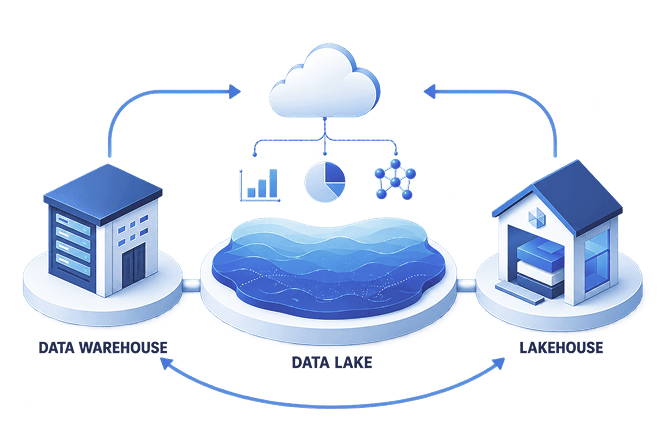
| Architecture | Best Choice When | Key Consideration |
|---|---|---|
Data Warehouse |
Your priority is financial reporting, KPI tracking, executive dashboards, and consistent business analytics. | Structured, validated, and highly governed data delivers reliable reporting and trusted metrics. |
Data Lake |
You need to collect and store large volumes of data from ERP, CRM, applications, files, APIs, IoT devices, and external sources. | Flexible storage supports analytics, AI, and future use cases but requires governance and quality controls. |
Lakehouse |
You want to combine reporting, advanced analytics, machine learning, and AI on a single platform. | Unifies BI and data science workloads while requiring a well-designed architecture and operating model. |
Get a free recommendation based on your data landscape, reporting needs, and growth plans.
Data lake companies get a flexible platform for scalable analytics, automation, and decision-making.

Data lake tools and technologies cover everything a modern business needs — from reliable storage to services for data integration and processing, along with analytics solutions. A single platform allows teams to work together and executives to see the big picture without gaps between systems.
It’s important to identify which sources to combine to form accurate business scenarios, and to set up processes so that managers get operational metrics, analysts get insightful insights, and product development teams get behavioral models for optimization.
Data lake solution providers create the basis for machine learning from historical data, event streams, labels, and segments. This allows you to use analytical models for business predictions, personalized recommendations, and metric classification without additional technical setup, as well as integrate ML platforms such as Azure ML and SageMaker without unnecessary barriers.
As one of the leading data lake consulting firms, we design architectures that align with the client's business logic. We provide scaling, storage policies, automatic archiving, and stable access to data. New sources are integrated quickly, and the system automatically separates current and archived data, optimizing costs.



Order data lake consulting services and receive a structured plan for designing, optimizing, or scaling your data lake architecture and data processing pipelines.
Or text us via Messenger



Let’s schedule a 30-minute online consultation so you can receive a solution design built around your business needs.
Or text us via Messenger























Request a technical review of your existing data lake environment. Our consultants analyze data pipelines, storage structures, and processing workflows to identify performance issues and opportunities for improvement.
Or text us via Messenger

Manufacturing

“Cobit Solutions quickly understood the complexity of our environment and delivered strong results across a wide range of subject areas. They adapted fast, worked effectively under tight timeframes, and consistently provided high-quality technical and business input throughout the project. We now see them as a consistent and valuable partner in our ongoing data journey.”
Josh Rammel
Global Head of IT

Distribution & Wholesale
“Second only to the Mona Lisa, it is the most beautiful work of art I’ve ever seen in my life… For real, it’s great. It’s exactly what we needed and we’re looking for. It’s good visualizing it that way. All is very good. This stuff’s awesome.”
Andrew Craft
President at Site Landscape Development

Logistics
“We want to express our sincere appreciation for all the support you’ve provided… From tackling urgent challenges like data upload to creating the initial flash report and making progress on complex issues; your contributions have been invaluable.”
Julia MacDonald
Group FP&A Manager

Retail
«Now all my data is updated every day. I take a look from time to time, when I’m making my own report, whether the numbers coincide. Having made sure it’s alright, I just carry on with my life in peace.»
Serhii Tupkalo
Board member, CFO at HELEN MARLEN L.P.

HoReCa
“The project helps us quickly and remotely see the information available for the company all over the world, besides it is updated daily.”
Olena Vasylevska
Chief Financial Officer of the chain of restaurants "Salateira"

IT companies
“Certainly, the automation of business analysis will contribute to the flexibility and efficiency of making important decisions for the company while maintaining high standards of information security.”
Oleg Avilov
CEO at SPAN

IT companies
“The work delivered by Cobit Solutions met all expectations and the team demonstrated their skill and expertise well. I highly recommend the services and look forward to future collaborations.”
Kateryna Ishchuk
Partnerships Director The App Solutions

Distribution & Wholesale
“Automation of business analysis helps us to see and control key metrics in real time, both of individual areas and of the entire business as a whole, which allows us to make timely and effective management decisions.”
Andrii Marchenko
Chief Information Officer of Frendt LLC

IT companies
“The developed perfectly looking BI templates allow our clients to quickly build their first report in Power BI and include the most relevant KPIs for reports.”
Anna Odrynska
Chief Strategy Officer at Alpha Serve

Healthcare
“Thanks to dashboards, we can also make a forecast of our financial indicators for a month, quarter or half a year and have the opportunity to compare the actual financial result with our predicted one – to understand the completeness of the reflection of expenses and income.”
Andrey Arbuzin
Deputy financial director