ERP Integration Service for Growing Enterprises






Key information is stored in one place and accessible to all decision-makers.

Core business areas — accounting, warehouse, procurement, CRM — are unified in one ERP system.

The system flexibly adapts to business growth, you get more customers, can consider new directions or expand team.

to identify key integration gaps



Custom ERP Integrations
- We analyze your business processes and IT infrastructure to determine whether you need cloud integration ERP or an on-premises system.
- We design a scheme for data exchange between ERP and other services, taking into account the specifics of the company.
- We set up integration via API, middleware or specialized solutions, launch and test the system.
Third-Party System Integrations
- We set up the ERP and BI data integration for sales so that data from CRM, e-commerce platforms, payment systems, and marketplaces automatically gets into ERP.
- We create a stable exchange of information between the systems: orders, payments, analytical reports are processed without delays and duplications.
- We connect services through APIs, webhooks, or ready-made connectors, depending on your tasks and technical capabilities.
Legacy System Integration
- We study the capabilities of old programs to find a way to connect to ERP without replacing the main software.
- If the API is missing or the functionality is limited, we find a solution through file sharing, databases, middleware, or special converters. We connect an ERP integration web service, if possible.
- We test the transfer of information: orders, payments, and balances should be updated without failures.
Real-Time Data Synchronization
- We customize systems so that all changes in ERP, CRM, financial programs, or e-commerce are reflected immediately without delay.
- We provide cloud integration ERP to exchange information between offices, warehouses, stores, or online services in different locations.
- We select solutions depending on the tasks: regular scheduled synchronization or full real-time data transfer.
- We check the stability of the systems: we exclude duplication, failures, loss, or delay of important information.
Data Migration
- We transfer information from one ERP system to another, preserving the structure of orders, balances, financial transactions, and customer base.
- We use ready-made ERP integration solutions to automate the transfer of large amounts of data without manual processing.
- We check the integrity and correctness of all information after the transfer is completed to ensure that there are no duplications, distortions, missing critical data, or discrepancies in financial indicators.
Do you have an ERP Integration project in mind?
Let's schedule 30-minutes online meeting to discuss your needs and get a detailed quote.
Or text us via Messenger



For the integration to work stably and really improve business processes, it is important to take into account the specifics of the company, the type of ERP, the features of CRM, accounting programs, and warehouse systems. That's why we offer a full cycle of the integration ERP — from initial analysis to post-launch support.

Analysis & Consultation
At this stage, we study the business structure: which systems are used, what is critical for accounting, how data is exchanged, which processes need automation, and whether cloud ERP integration is significant. We analyze which processes are duplicated, where information loss or errors can potentially occur. We formulate recommendations and provide advice on the best ERP integration solution.
Solution Design
Then we create an individual integration scheme, taking into account what data needs to be synchronized, in what mode, and between which systems. We choose the tools: API, middleware, or web services. We prepare technical documentation and agree on key stages with the client.
Implementation
What is important to consider at this stage? We understand that any system should work without failures and without stopping business processes. Therefore, the implementation is carried out in stages: each integration module — finance, CRM, warehouse — is aligned with the real logic of the company's work. We set up all the connections without interfering with critical operations so that the launch does not cause conflicts or stoppages.
Testing & Quality Assurance
At this stage, we check the correctness of the integration in real-life scenarios: from order processing to synchronizing financial data. Testing takes place in a controlled environment. Special attention is paid to the stability of API connections, data compliance, and performance to ensure that your business operates smoothly and without unpleasant surprises.
Support & Maintenance
After implementation, we do not leave the client. To ensure that the system continues to work under control, we include technical support, monitoring and updating of integration schemes in our ERP integration services. This is especially important when the company changes processes or adds new systems. In this case, we can set up additional data exchange scenarios and adapt existing solutions.

Testimonials for Our Business Intelligence Services

Manufacturing

Steelite International USA
“Cobit Solutions quickly understood the complexity of our environment and delivered strong results across a wide range of subject areas. They adapted fast, worked effectively under tight timeframes, and consistently provided high-quality technical and business input throughout the project. We now see them as a consistent and valuable partner in our ongoing data journey.”
Josh Rammel
Global Head of IT

Distribution & Wholesale
Site Landscape Development
“Second only to the Mona Lisa, it is the most beautiful work of art I’ve ever seen in my life… For real, it’s great. It’s exactly what we needed and we’re looking for. It’s good visualizing it that way. All is very good. This stuff’s awesome.”
Andrew Craft
President at Site Landscape Development

Logistics
Self-Storage Facilities in 6 countries
“We want to express our sincere appreciation for all the support you’ve provided… From tackling urgent challenges like data upload to creating the initial flash report and making progress on complex issues; your contributions have been invaluable.”
Julia MacDonald
Group FP&A Manager

Retail
“HELEN MARLEN” fashion boutiques
«Now all my data is updated every day. I take a look from time to time, when I’m making my own report, whether the numbers coincide. Having made sure it’s alright, I just carry on with my life in peace.»
Serhii Tupkalo
Board member, CFO at HELEN MARLEN L.P.

HoReCa
“Salateira” restaurants chain
“The project helps us quickly and remotely see the information available for the company all over the world, besides it is updated daily.”
Olena Vasylevska
Chief Financial Officer of the chain of restaurants "Salateira"

IT companies
SPAN
“Certainly, the automation of business analysis will contribute to the flexibility and efficiency of making important decisions for the company while maintaining high standards of information security.”
Oleg Avilov
CEO at SPAN

IT companies
The App Solutions
“The work delivered by Cobit Solutions met all expectations and the team demonstrated their skill and expertise well. I highly recommend the services and look forward to future collaborations.”
Kateryna Ishchuk
Partnerships Director The App Solutions

Distribution & Wholesale
Frendt LLC
“Automation of business analysis helps us to see and control key metrics in real time, both of individual areas and of the entire business as a whole, which allows us to make timely and effective management decisions.”
Andrii Marchenko
Chief Information Officer of Frendt LLC

IT companies
Alpha Serve
“The developed perfectly looking BI templates allow our clients to quickly build their first report in Power BI and include the most relevant KPIs for reports.”
Anna Odrynska
Chief Strategy Officer at Alpha Serve

Healthcare
“Dobrobut” clinics chain
“Thanks to dashboards, we can also make a forecast of our financial indicators for a month, quarter or half a year and have the opportunity to compare the actual financial result with our predicted one – to understand the completeness of the reflection of expenses and income.”
Andrey Arbuzin
Deputy financial director


LEAVE A REVIEW FOR OUR ERP Integration Service for Growing Enterprises
3 Reasons to Choose Us for ERP Integration Services

Proven Track Record in ERP Implementations
We have extensive experience in implementing ERP integration solutions in various areas: e-commerce, manufacturing, logistics, finance, and others. We understand the specifics of each business and know how to set up the system without unnecessary interruptions.

Expertise in Leading ERP Platforms
We work with cloud and on-premises solutions: SAP, Microsoft Dynamics, Odoo, NetSuite, and others. We select the best approach for a particular system.

Scalable and Future-Ready Solutions
Our integrated ERP solution is designed to accommodate business growth. Then new branches, sales channels, and additional services do not require a complete system upgrade. This eliminates the need to regularly redesign the infrastructure. But if your ERP system itself changes, specific services are added, or business processes are radically restructured, we help you adapt the solution or set up new scenarios.












Work with a trusted ERP integration team starting at $60/hour
Order ERP integration services and get a clear implementation plan aligned with your financial, operational, and reporting processes.

Why businesses choose our ERP integration services
To keep processes aligned, we integrate ERP platforms with core systems and analytics, ensuring consistent data exchange and real-time operational visibility. This enables consistent data exchange and real-time operational visibility.

Start in 1 week, work on EST hours, get results fast

25+ Data, BI & Finance experts ready to help

8+ years delivering data solutions in 22+ industries

Trusted by 70+ clients across 5 countries

Save 40% vs. building the same team in-house

Full end-to-end delivery, from DWH to support & AI







Need a reliable ERP integration tailored to your growth strategy? Build a connected system designed for control, transparency, and scalable expansion.
ERP Integration Service Case Studies

Healthcare
“Dobrobut” clinics network
Result:
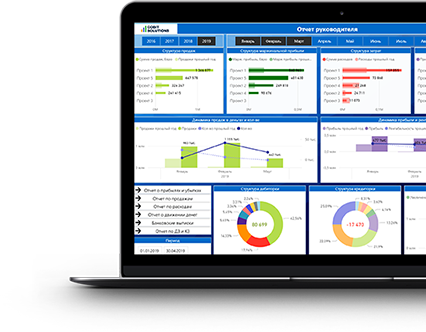
- The clinic’s directors receive a P&L report updated daily.
- Management uses a daily dashboard for budget-versus-actual analysis of operational indicators.
- Dashboards combine data from ERP and the Doktor Eleks medical system.

Logistics
Meest China
Result:
- Dashboards combine data from ERP and CRM.
- Route margins are automatically calculated in dashboards and monitored every day by management.
- A Profit & Loss report is generated daily.

Manufacturing
Steelite International USA
Result:
- Automated reporting, reducing turnaround from 10 days to overnight.
- Scaled visibility from regional to global (US, UK, Canada, Europe, Australia).
- Centralized data enabled data-driven decisions on a weekly cadence instead of monthly.
Industry-focused case studies designed for your needs