Where is your financial institution losing money, what risks can be seen early, and what already has a measurable effect? ​​We analyze the experience of Cobit Solutions and international banks.
2–3×
greater attention to personalized
offers
18 %
higher customer retention
rate
15–20 %
lower risk of problem
loans
by 67.6%
fewer cases of financial
losses
до 3×
more AML schemes
detected
It is through these indicators that bank owners and managers look at the data.
More sales per customer
Fewer credit losses
Accurate capital planning
Lower operating costs
In this article, we will analyze 10 practical scenarios for using analytics in banks.
You will see:
In the material, we rely on the experience of our company Cobit Solutions and open cases of international banks, since due to NDA we cannot name clients from our own banking projects.
Let’s start with the question that comes first for any business.
OPERATIONAL EFFICIENCY
Now let’s move on to Cost-to-Income. Where does the bank spend money every day? Cash, collection, employee labor, maintenance of a large network of equipment.
On the scale of a large financial institution, even a few percent savings turn into significant amounts.
Cash flow optimization
Generative AI assistant
Predicting ATM failures
Let’s imagine a client who has just purchased airline tickets. For the bank, this is a signal: in the near future he may need insurance, favorable conditions for payments abroad or another travel product.
There can be hundreds of such signals: an increase in the balance, a regular payment, a change in the cost structure, a new large transfer. Predictive analytics allows you to process these signals and determine which product is most likely to interest a particular client.
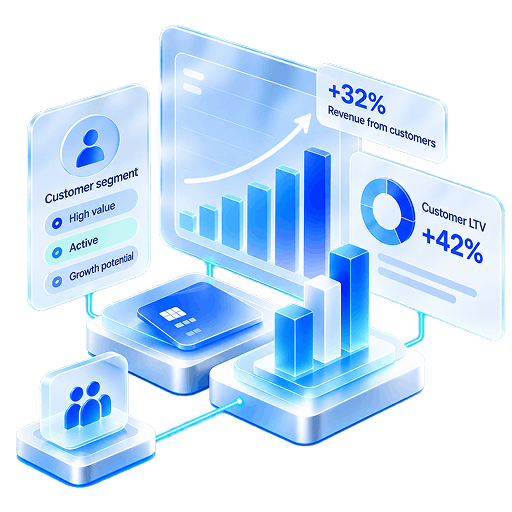
In our experience, personalized offers can attract the attention of customers 2–3 times more often.
Personalized offers can be 2–3 times more likely to attract customer attention.
When should you start working with a client who may leave? The best time is before the account is closed. The first signals appear earlier. The client uses the card less often, transfers regular payments to another bank, reduces balances or reduces account turnover.
Predictive analytics helps to combine these changes and identify clients with a high risk of churn.
In one of our cases, a European bank used machine learning to predict the churn of banking customers. A targeted campaign helped increase the level of active client retention by 18%.
Higher customer retention.
Can data help a bank find additional sources of revenue? Yes. Aggregated analytics allows you to study consumer activity, payment structure, behavior of individual segments, and changes in demand. Based on such findings, a bank can find new opportunities in existing products or create separate analytical services for corporate clients and partners.
In one of the cases Visa a large American card issuer used analytics to identify lost opportunities for generating commission income. After the changes, the portfolio’s return increased by 3%, and the bank began to receive an additional $100,000 per year.
Portfolio
returns increased
Additional income per year
How is data converted into revenue?
Signal
The customer changes behavior, balances, payments, or activity.
Forecast
The model identifies a need, risk, or potential opportunity.
Action
The bank launches a personal offer, contact, or other scenario.
Effect
The bank increases sales, retains customers, and finds new sources of income.
INCOME PROTECTION
Two clients may have similar credit ratings and completely different levels of risk. For a more accurate assessment, the bank can use predictive analytics built on machine learning models. Such models take into account cash flow, transaction behavior, business characteristics, and other available factors.
Based on this data, it is possible to more accurately assess the probability of loan default. The results of the analysis help when making a decision, determining the limit and rate, and further monitoring the borrower.
In our experience, using ML models helps reduce the risk of problem loans by 15–20%.
15-20 % lower risk of problem loans
The loan has been granted. What happens to the risk next? After all, the borrower’s financial condition can change. A drop in turnover, a decrease in revenues, an increase in debt burden, and a change in payment behavior can indicate a future problem.
The early warning system based on predictive analytics collects such signals and forms a list of clients that need attention.Â
So the risk team gets the opportunity to work with them earlier and set priorities correctly.
In World Bank 2025 study, ML helped prevent 67.6% of incidents that could have led to financial losses.
67.6% of financial losses were prevented
One suspicious transaction may not show anything. But what if you look at the entire chain?Â
Machine learning and network analysis help find connections between accounts, payments, and participants that remain invisible when checking individual transactions.
A case in point is the international project Aurora of the Bank for International Settlements.
During testing, the combination of machine learning, network analysis, and data protection technologies allowed detectingup to three times more complex money laundering schemes.
The number of false positives was reduced by 80%.
up to 3× more complex AML schemes · 80% fewer false positives
What will happen to a bank’s portfolio during a deep recession? Scenario modeling helps answer this question. A bank can estimate potential losses, revenues, expenses, and capital levels under different economic conditions.
In 2026, the Federal Reserve examined 32 large banks, including Bank of America, JPMorgan Chase, Citigroup, Goldman Sachs, Capital One, and Wells Fargo.
Under a deep global recession scenario, cumulative losses could exceed $708 billion, and the Tier 1 capital ratio would decline by 1.6 percentage points.Â
At the same time, all 32 banks maintained capital above minimum regulatory requirements and were able to continue lending.
$708 billion of potential losses identified for just part of 2026
In addition to regulatory reviews, banks can conduct their own internal stress tests for specific risks and management tasks. For example, they can simulate a sharp increase in delinquencies, a change in interest rates, or a deterioration in the situation in a particular credit segment. Such calculations help to assess the capital buffer in advance, adjust credit policy, and prepare for possible changes in the market.
OPERATIONAL EFFICIENCY
Now let’s move on to Cost-to-Income. Where does the bank spend money every day? Cash, collection, employee labor, maintenance of a large network of equipment.
On the scale of a large financial institution, even a few percent savings turn into significant amounts.
Cash flow optimization
Generative AI as an assistant
Predicting ATM failures
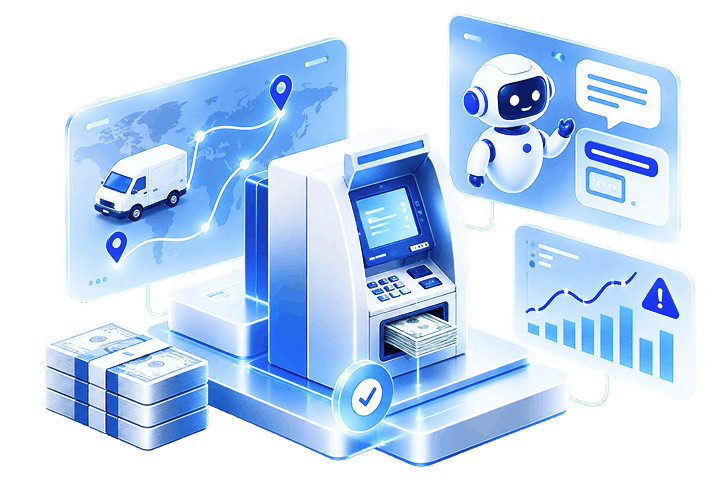
How much cash does a particular ATM need tomorrow? The answer can be predicted. The model takes into account transaction history, day of the week, seasonality, holidays, location, and other factors. Based on the forecast, the bank plans ATM replenishment and collection routes.
Cobit Solutions estimates that cash handling can account for 5–9% of a bank’s total operating costs. However, almost half of our clients used manual calculations to forecast branch and ATM needs.
of the bank's operating expenses may be related to cash handling
How much time does a bank employee spend searching for a document, internal policy, or necessary instruction?
A corporate AI assistant can find information, summarize documents, and help prepare for a meeting. Such solutions are already being used in real banking processes.
One ​​of the most striking examples is Bank of America. Erica’s internal assistant is used by over 90% of bank employees, and the number of calls to IT support has decreased by more than 50%.
employees use Erica, and the number of support requests has decreased by 50%
ATM failures can also be predicted. The equipment constantly generates event logs, error messages, and technical indicators. Machine learning models analyze this data and find signs that may precede the failure of individual components.
This approach was used by Bank of New Zealand. The predictive maintenance system helped the bank reduce ATM downtime by a third, reduce errors by 65%, and maintenance costs by 30%.
reducing ATM downtime
reducing maintenance costs
Where does the bank save money every day?
Cash and collection
more accurate replenishment forecasts and better routes
Employee time
faster access to documents and instructions
Equipment
there are significantly fewer downtimes and emergency repairs
Processes
lower operating costs and stable service
Let’s say a bank wants to launch personalization. Where does the data reside? Some of it is in CBS. Some is in CRM, card processing, mobile banking, and credit systems.
Metrics can have different formats, calculation rules, and update frequencies. Combining these sources creates the most complex part of an analytics project.
Most of the scenarios described require information from multiple systems at once. Therefore, the first task is to integrate the sources and create a common data environment.
The model inherits the problems of the original data. Duplicates, omissions, different calculation rules, and errors directly affect the result.
New solutions often integrate with systems that have been operating for decades. The architecture must ensure stable data exchange and the ability to connect new scenarios.
A full-fledged analytics system requires architects, data engineers, BI specialists, analysts, and machine learning specialists. The team must simultaneously understand the technology and the bank's business objectives.
Access to banking data requires clear rules. Roles, logging, privacy, model control, and regulatory compliance are built into the project architecture.
As a result, a separate scenario turns into a system task.
Technical basis
All 10 scenarios we discussed above require quality data, the right architecture, and analytical models.
Cobit Solutions can close this technology loop — from the unification of banking systems to predictive analytics and AI-based solutions.
We will combine transactional and customer data and prepare it for predictive analytics. We will build machine learning models for personalized offers.
We will build a predictive model that identifies customers with an increased risk of churn. It will help form target groups for retention.
We will create a single repository and prepare aggregated data sets. We will build analytical products for internal teams, corporate clients or partners.
We will develop machine learning models for credit risk assessment. We will integrate the results into the bank's analytical system.
We will set up predictive models and an early warning system that will help identify borrowers with increased risk.
We will combine transaction flows and prepare data for anomaly detection. We will build models to search for suspicious transactions and patterns.
We will build scenario models for different economic conditions. They will show the possible impact on the loan portfolio, profit and capital.
We will create predictive models to plan the cash needs of ATMs and branches. We will visualize the results in Power BI.
We will prepare corporate data for working with large language models. We will create internal AI solutions for searching, analyzing, and processing information.
We will build predictive maintenance models. We will use event logs, fault history, and equipment performance for analysis.
To implement such solutions, the Cobit Solutions team works with data integration, ETL/ELT, DWH, Data Lake and Lakehouse, Power BI, predictive analytics, machine learning, and AI. We can separately build a data management system, configure quality control, access, and prepare a single analytical framework for multiple scenarios.
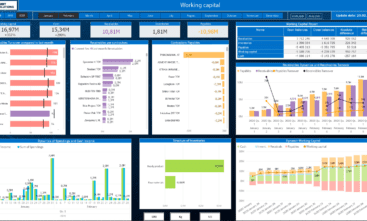
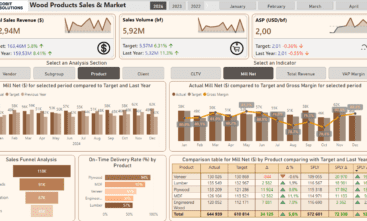
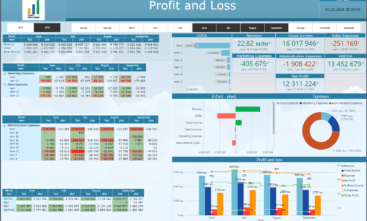
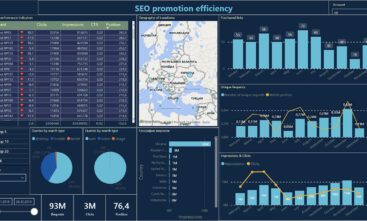
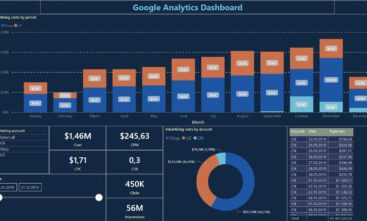
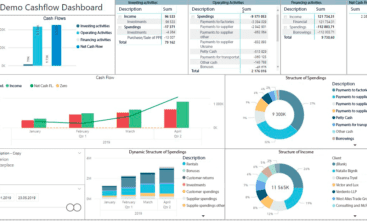
Due to data confidentiality, we do not publish actual dashboards. Below are a few examples that demonstrate the capabilities of Power BI and Cobit Solutions' approach to business data visualization.
Healthcare
Result:
Logistics
Result:
Manufacturing
Result:
Industry-focused case studies designed for your needs

fill in the form to get the whitepaper